 freebirdcapital
Over long periods, a share price follows the company's earnings. Long-term success therefore needs two things: a company whose earnings grow, and a purchase price that does not already anticipate that growth. If one is missing, the other helps little.
Where the return comes from
The return of a share over many years can be broken down into three sources: growth in earnings per share, the dividend, and the change in valuation — whether the market pays more or less for one euro of earnings at the end than at purchase.
The first two sources are delivered by the company, the third by the investor — through the price paid. That gives the two keys.
The first key: a fair price
My reference for a fair price is a price-to-earnings ratio around 15 — as an upper limit: when interest rates are high, my yardstick is lower (see the fair value calculator). That corresponds to an earnings yield of 6.7 % — a level a sound company can earn sustainably. The long-term average of the US market is of the same order, depending on the period and definition of earnings. For companies with clearly higher growth, a second rule of thumb applies: a P/E equal to the expected growth rate is still fair (more in the article on the price-to-earnings ratio).
Both are yardsticks, not laws of nature. But they prevent the most common mistake: a purchase that only works if the market still pays as much for the company in ten years as it does today.
The second key: growing earnings
The only lasting reason to own a share is the profit the company earns for its owners. Dividends are paid from it, and its growth carries the price. A low P/E alone is therefore not enough: a company without earnings growth often stays cheap for good reason.
What the entry price makes of the same company
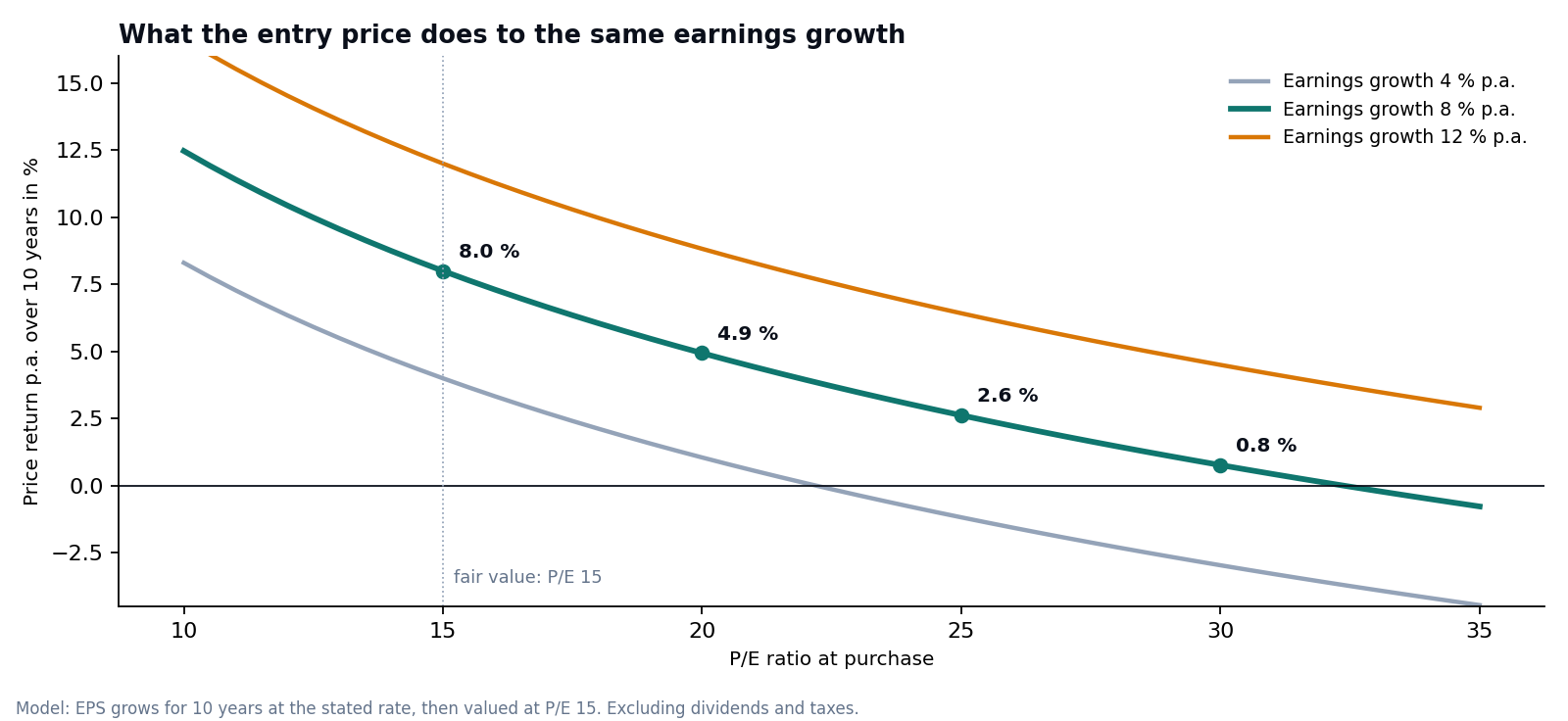
A company earns €5 per share today; earnings grow by 8 % a year for ten years to €10.79. At the end, the market values it at the fair P/E of 15, i.e. at €162. Only one thing changes: the price at which I buy today.
| P/E at purchase | Price | 4 % growth | 8 % growth | 12 % growth |
|---|---|---|---|---|
| 15 (fair) | €75 | 4.0 % | 8.0 % | 12.0 % |
| 20 | €100 | 1.1 % | 4.9 % | 8.8 % |
| 25 | €125 | −1.2 % | 2.6 % | 6.4 % |
| 30 | €150 | −3.0 % | 0.8 % | 4.5 % |
The same company, the same growth — and a return between 8 % and 0.8 % a year. Buying at twice the fair price takes ten years just to work off the overvaluation. Conversely, the bottom line shows the trap of the supposedly cheap: with weak growth, even a fair price helps only so much.
In the plant, this is the same calculation as for a machine: the purchase price is the initial outlay, earnings per share the return flow. Paying too much depresses the internal rate of return — however good the machine. More on this logic in the article on return on invested capital (ROIC).
What I take from it
- Quality first, then price — but both, without exception.
- Write down a fair value before buying, so the price does not become the yardstick after the fact — the fair value calculator computes exactly this table for your own figures.
- Keep growth assumptions conservative — the calculation forgives a slightly slower growth rate more readily than too high a price.
Foundations: B. Graham, D. Dodd: Security Analysis; historical S&P 500 P/E series by R. Shiller (multpl.com). Model with own figures.